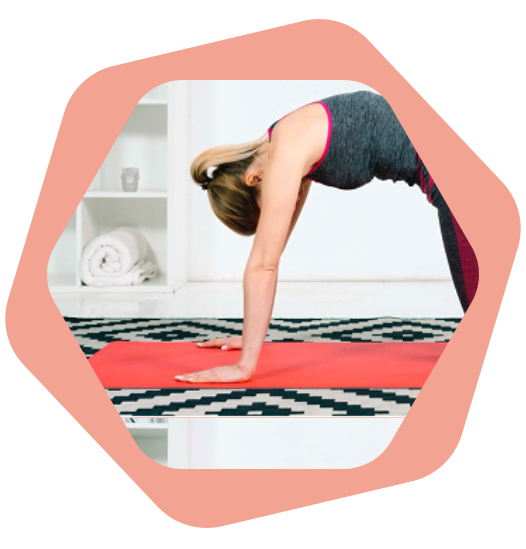
Home-based physiotherapy exercises help you recover faster by building strength, improving flexibility, and managing pain without needing expensive equipment or daily clinic visits. Discover these seven simple, no-equipment movements you can start today to speed up your journey back to full health and regain your independence.
By: MedGo2U Editorial Team
Medically Reviewed by: Ken Hong
Reviewed on: Nov 25, 2025
Date Published: Nov 25, 2025
Date Modified: Nov 25, 2025
What is Physiotherapy at Home?
Physiotherapy at home means you receive comprehensive rehabilitation services in the comfort of your own living environment. Instead of having to travel to a clinic, a qualified physiotherapist comes to you to deliver a tailored treatment plan or guides you through a personalized home exercise program (HEP) (Activ Therapy, 2024).
This approach allows your therapist to design exercises that make sense in your daily life. They focus on functional activities, like helping you navigate your stairs or safely stand up from your favorite sofa.
Who Can Benefit from Physiotherapy at Home?
Home-based physiotherapy is a powerful solution for a wide range of individuals, including you, if you are:
- •Recovering from Surgery: If you've had a major procedure like a total knee or hip replacement, you need immediate, consistent and safe mobility training right away (UT Health Austin, 2025).
- •An Older Adult: This therapy improves your balance, strength, and confidence, which significantly reduces your risk of falls and keeps you independent (UCLH, 2024).
- •Living with Chronic Pain: If you deal with ongoing issues like back pain, neck tension or arthritis, you can manage your symptoms better through consistent, targeted movement (MYo Lab Health & Wellness, 2025).
- •Having Trouble Traveling: If leaving your home is difficult due to injury, illness or disability, receiving care at home removes a significant barrier to your recovery success (Focusphysiotherapy, 2017).
Research clearly indicates that consistently following your home exercise program reinforces the gains you make in therapy, leading to long-term improvements in your physical health and function (Limber Health, 2025).
Why Choose Home Physiotherapy Exercises?
The decision to receive physiotherapy and perform your exercises at home offers several key benefits that dramatically enhance your rehabilitation:
- •You Achieve Better Consistency: You eliminate the travel time and scheduling hurdles of clinic visits, making it incredibly easy for you to be consistent with your routine. Consistency is the single most important factor in speeding up your recovery (Limber Health, 2025).
- •Your Practice is Relevant: You perform the exercises in the exact environment where you need to function every day. This high level of practicality, using things like your own chair or stairs, makes the training more effective for daily life (Focusphysiotherapy, 2017).
- •You Feel More Comfortable and Focused: Being in your familiar home space helps you feel more relaxed and focused on the movements, which can lead to better technique and better overall treatment outcomes (Focusphysiotherapy, 2017).
7 Easy At-Home Physio Exercises for Recovery (No Equipment)
These exercises are foundational movements used in physiotherapy to improve your strength, mobility, and stability. Before starting, always consult your healthcare professional or a qualified physiotherapist. Perform each exercise slowly and deliberately, focusing on the right form. Aim for 2–3 sets of 10–15 repetitions unless otherwise noted.
1. Sit-to-Stand (Functional Strength)
What it does: This movement strengthens your quadriceps and glutes, which is essential for maintaining your ability to get up from a chair, a core daily activity.
How to do it:
- •Sit on the edge of a sturdy, non-wheeled chair. Make sure your feet are flat on the floor and about hip-width apart.
- •Lean forward slightly and push through your feet to stand up slowly and smoothly.
- •Control your movement as you slowly lower yourself back down to the chair.
- •Use your hands only for gentle guidance on the chair or your thighs, if you need it.
2. Glute Bridge (Core & Lower Back Stability)
What it does: This strengthens your glutes, hamstrings, and core muscles. All vital for supporting your lower back.
How to do it:
- •Lie flat on your back. Bend your knees and place your feet flat on the floor, keeping them about hip-width apart.
- •Tighten your abdominal muscles and squeeze your glutes (buttocks).
- •Slowly lift your hips off the floor until your body forms a straight line from your shoulders to your knees.
- •Hold this position for 3–5 seconds.
- •Slowly and with control, lower your hips back down to the floor.
3. Wall Push-Up (Upper Body Strength)
What it does: This is a low-impact way to build strength in your chest, shoulders, and arms without straining your joints.
How to do it:
- •Stand facing a wall, about arm's length away. Place your palms flat against the wall at shoulder height.
- •Keep your body straight from head to heel. Slowly bend your elbows to bring your chest closer to the wall.
- •Push back through your palms until your arms are straight and you return to the starting position.
4. Straight Leg Raise (Knee and Hip Strengthening)
What it does: This targets your quadriceps (thigh muscles) and hip flexors, commonly used after knee surgery.
How to do it:
- •Lie flat on your back. Bend one knee and place that foot flat on the floor. Keep the other leg straight, with your toes pointing up.
- •Slowly lift the straight leg about 30° to 45° off the floor.
- •Make sure your knee stays straight throughout the lift.
- •Hold the leg up for a moment, then slowly lower it back down.
5. Heel Slides (Knee/Hip Mobility)
What it does: This gently improves the range of motion in your knee and hip joints through controlled movement.
How to do it:
- •Lie flat on your back with both legs straight.
- •Slowly slide one heel along the floor, bending the knee toward your chest as far as is comfortable.
- •Don't force the movement if you feel sharp pain or excessive tension.
- •Slowly slide the heel back to the starting position.
- •Alternate legs and repeat.
6. Chin Tucks (Neck Posture and Pain Relief)
What it does: This corrects forward head posture and strengthens the deep neck flexor muscles, helping to relieve your tension headaches and neck pain.
How to do it:
- •Sit or stand up straight. Keep your shoulders relaxed.
- •Gently pull your chin straight back, as if you are trying to make a "double chin."
- •Keep your eyes level and avoid tilting your head up or down.
- •You should feel a gentle stretch at the back of your neck. Hold this position for 3–5 seconds.
- •Slowly release the chin forward.
7. Standing Marches (Balance and Coordination)
What it does: This improves your walking coordination, hip flexor strength, and overall balance.
How to do it:
- •Stand tall behind a sturdy chair or countertop and hold on for support.
- •Slowly lift one knee toward your chest.
- •Lower your foot back down with control.
- •Alternate between the left and right legs, moving at a steady, rhythmic pace.
- •Throughout the exercise, focus on standing up straight and controlling the movement as your foot descends.
Safety & Tips
- •Listen to Your Body: You might feel some muscle fatigue or stretching, but sharp or increasing pain is a clear sign to stop (NHS, 2011). Never push through pain.
- •Focus on Form: Doing the exercise correctly is more important than the number of repetitions. Use a mirror or ask someone to watch to ensure you have the right technique (Virtuelife, 2025).
- •Breathe: Never hold your breath. Breathe out when you exert effort (the lifting/pushing part) and breathe in as you return to the start.
- •Stay Hydrated: Keep water handy, especially during longer sessions.
- •Be Consistent: Your recovery benefits far more from doing a small number of exercises every day than from one long, intense session a week (Virtuelife, 2025).
Conclusion
Taking an active role in your recovery by sticking to a home exercise program is the most effective way to speed up your healing. These seven no-equipment physiotherapy exercises, from the functional Sit-to-Stand to the stabilizing Glute Bridge, provide a strong foundation for you to regain strength, improve mobility, and manage pain.
By fitting these simple movements into your daily routine, you reinforce the progress you make with your therapist and regain your independence faster. If you need a detailed plan tailored exactly to your specific injury or condition, always consult a registered physiotherapist.
If you're looking for a physiotherapist in London, book an appointment with Parth V., a verified HCPC-registered physiotherapist offering home and video consultations across the city.
Frequently Asked Questions
Q1. How often should I do my home physiotherapy exercises?
Consistency is vital for fast recovery. Most physiotherapists recommend you perform your specific exercises at least once per day, and often two to three times per day, especially for mobility work. Focus on regularity over high intensity.
Q2. Can physiotherapy exercises I do at home replace clinic visits?
No. Home exercises are an essential part of physiotherapy, helping you reinforce progress between sessions. However, they don't replace the expert assessment, hands-on manual therapy, or specialized equipment that a qualified physiotherapist provides.
Q3. What should I do if exercise causes pain?
Stop immediately. Feeling fatigue is fine, but sharp pain means you're pushing too hard or using the wrong form. If the pain continues, contact your physiotherapist before trying the exercise again.
Q4. What is a 'Repetition' and a 'Set'?
A Repetition (Rep) is one complete performance of an exercise (e.g., standing up once). A Set is a group of repetitions you perform consecutively (e.g., doing 10 repetitions is one set).
Join the movement for fair and flexible healthcare
WORK WITH MEDGO2U
Are you a qualified HCPC-registered physiotherapist looking for flexible work across London or the UK? Join MedGo2U and start providing home visits or online consultations at your convenience.
References
- Activ Therapy. (2024). Physiotherapy Exercises for Home Recovery.
- Focusphysiotherapy. (2017). 7 Benefits Of In-Home Physiotherapy.
- Limber Health. (2025). Physical Therapy Home Exercises: Key Benefits of Consistency.
- MYo Lab Health & Wellness. (2025). Physiotherapy Exercises You Can Do at Home.
- NHS. (2011). Strength exercises.
- UCLH. (2024). Home exercises to improve strength and balance following hospital admission.
- UT Health Austin. (2025). Nine Physical Therapy Exercises You Can Do at Home.
- Virtuelife. (2025). Physio Exercises at Home: Your Guide to Safe and Effective Recovery.
About the Reviewer
Ken Hong is a Band 6 Physiotherapist working within the Manchester NHS across both ward and community settings. He holds a BSc in Sport and Exercise Science and an MSc in Physiotherapy (Pre-registration) from the University of Birmingham. Ken has strong clinical experience in assessing, diagnosing and treating a wide range of musculoskeletal and post-operative conditions. His background in exercise science enhances his ability to design effective, evidence-based rehabilitation programmes that improve mobility, strength and overall recovery.
Medical Disclaimer
This content is for educational purposes and not a substitute for professional medical advice.
Last medically reviewed on: Nov 25, 2025
Follow us to hear more




Written by MedGo2U Editorial Team
Nov 25, 2025 • 12 minutes read