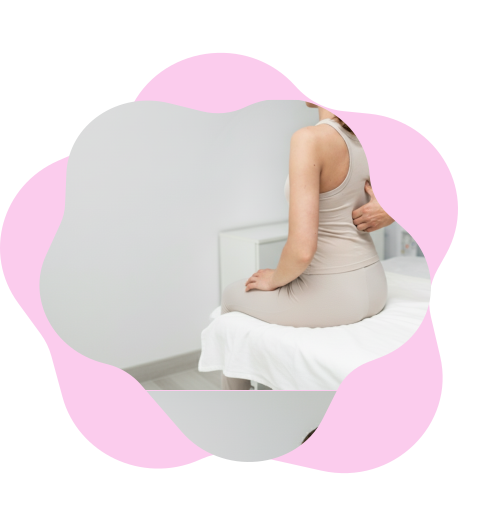
Back pain is one of the single greatest causes of disability globally, and in the UK, it accounts for millions of lost workdays every year. Fortunately, the most effective, evidence-based treatment for the vast majority of non-specific back pain isn't surgery or strong medication—it's physiotherapy. Physiotherapy offers a practical, active path to recovery by strengthening your core, improving mobility, and teaching you the habits needed to keep the pain away for good.
By: MedGo2U Editorial Team
Medically Reviewed by: Ken Hong
Reviewed on:
Date Published:
Date Modified:
Why Physiotherapy is the UK Standard for Back Pain
For decades, the standard medical advice for back pain was rest. However, current clinical guidelines from the National Institute for Health and Care Excellence (NICE) in the UK strongly recommend against prolonged rest. Instead, staying active and engaging in an exercise programme (which is the core of physiotherapy) is the most effective approach for both acute (sudden) and chronic (long-term) lower back pain (NICE, 2020).
A UK-registered physiotherapist (regulated by the Health and Care Professions Council, HCPC) uses a systematic approach:
- Accurate Assessment: Identifying the type of pain (e.g., mechanical, nerve-related) and its true source, which often lies in weakness of the core, hips, or poor posture.
- Targeted Treatment: Creating a plan that combines hands-on techniques with specific exercises to address the underlying cause, not just the symptom.
- Education: Teaching you how to manage your back, understand your pain triggers, and adapt your daily activities to prevent recurrence.
Common Back Pain Conditions Physiotherapy Treats
Physiotherapy is highly successful in managing the majority of back issues that do not require emergency medical attention:
- Non-Specific Lower Back Pain: This is the most common diagnosis, where pain doesn't have a single, clear, serious cause. It responds exceptionally well to exercise and education.
- Sciatica (Radicular Pain): Pain that travels down the leg, often caused by a pinched nerve root in the lower spine (e.g., from a bulging disc). Physiotherapy uses gentle movements and nerve gliding exercises to relieve pressure and reduce leg symptoms (Chartered Society of Physiotherapy, 2023).
- Degenerative Disc Disease: Age-related wear and tear of the spinal discs. While this cannot be reversed, strengthening the supporting muscles stabilises the spine, dramatically reducing associated pain and improving function (Spine Health, 2024).
- Muscle Spasm and Strain: Acute pain caused by overstretching or sudden movements. Treatment focuses on manual therapy for immediate relief, followed by strengthening to prevent future spasms.
Research shows that patients who receive early physiotherapy intervention for acute low back pain have better outcomes, report less pain, and use less opioid medication compared to those who delay treatment (Health Services Research, 2018).
4 Essential Exercises for Back Strength and Relief
Consistency with a safe exercise program is the "secret sauce" of physiotherapy for back pain. Always consult a physiotherapist before starting any new exercise routine.
Pelvic Tilts:
- Goal: To gently restore movement in the lower spine and engage deep abdominal muscles (the true core).
- How: Lie on your back with knees bent and feet flat. Flatten your lower back against the floor by gently tightening your stomach muscles and tucking your pelvis up slightly. Hold for 5 seconds and release. Repeat 10 times.
Bridging:
- Goal: Strengthens the glutes and hamstrings, which are vital support muscles for the spine.
- How: From the pelvic tilt position, press your heels into the floor and slowly lift your hips up until your body forms a straight line from your shoulders to your knees. Avoid arching your lower back. Hold for 5 seconds and slowly lower. Repeat 10-15 times.
Cat-Cow Stretch:
- Goal: Improves mobility and flexibility throughout the spine in a safe, weight-supported position.
- How: Start on your hands and knees. Inhale, letting your stomach drop and gently lifting your head (Cow position). Exhale, tucking your chin to your chest and rounding your spine toward the ceiling (Cat position). Repeat smoothly for 1 minute.
Bird-Dog:
- Goal: Develops core stability and balance while strengthening the low back.
- How: Start on hands and knees. Slowly extend your right arm straight forward and your left leg straight back, keeping your back flat and hips level. Return to start and switch sides. Alternate for 10 repetitions on each side (Harvard Health, 2021).
Safety & Prevention Tips
Physiotherapy isn't just treatment; it's a long-term preventative strategy.
- Maintain Movement: Avoid prolonged sitting. Set a timer to stand, stretch, and walk around every 30-45 minutes. Research shows that prolonged sitting is an independent risk factor for chronic low back pain (The Lancet, 2022).
- Lifting Technique: Always lift with your legs, keeping the load close to your body. Avoid twisting motions while lifting.
- Sleep Hygiene: Sleep on a firm mattress that supports the natural curve of your spine. If you sleep on your side, place a pillow between your knees.
- Ergonomics Check: Ensure your desk, chair, and computer monitor are set up to support a neutral, upright posture while working.
Conclusion
Physiotherapy is the definitive, evidence-based treatment for the vast majority of back pain conditions in the UK. By focusing on active rehabilitation, personalized exercise programs, and expert patient education, a physiotherapist equips you with the strength and knowledge to not only overcome current pain but also to prevent its return. Do not surrender to rest and pain medication; choose the active path to a stronger, pain-free back.
If you're looking for a physiotherapist in London, book an appointment with Parth V., a verified HCPC-registered physiotherapist offering home and video consultations across the city.
Frequently Asked Questions
Should I use heat or ice for my back pain?
For acute back pain (in the first 48 hours), ice can help reduce inflammation and pain. For chronic back pain, or muscle stiffness, heat is generally recommended as it helps relax tight muscles and increase blood flow. Always choose what feels better for your specific symptoms.
How long does it take for physiotherapy to fix back pain?
The duration varies widely. For simple, acute strains, significant relief can be found within 2 to 4 weeks. For chronic pain (lasting over 12 weeks), a comprehensive treatment plan may take 8 to 12 weeks of structured therapy, with continuous self-management exercises thereafter to maintain results.
Can I do physiotherapy if I have a slipped disc?
Yes, in most cases. The term "slipped disc" usually refers to a bulging or prolapsed disc. Physiotherapy is the primary non-surgical treatment and includes specific exercises (like the Cat-Cow stretch or extensions) to relieve pressure on the nerve, improve mobility, and strengthen the supporting muscles to stabilise the spine.
Join the movement for fair and flexible healthcare
WORK WITH MEDGO2U
Are you a qualified HCPC-registered physiotherapist looking for flexible work across London or the UK? Join MedGo2U and start providing home visits or online consultations at your convenience.
References
- NICE. (2020). Low back pain and sciatica in over 16s: assessment and management.
- Chartered Society of Physiotherapy. (2023). Understanding Sciatica.
- Health Services Research. (2018). Early physical therapy for acute low back pain.
- Spine Health. (2024). Physical Therapy for Degenerative Disc Disease.
- Harvard Health Publishing. (2021). 6 exercises for a stronger back.
- The Lancet. (2022). Sedentary behaviour and low back pain: a systematic review and meta-analysis.
About the Reviewer
Ken Hong is a Band 6 Physiotherapist working within the Manchester NHS across both ward and community settings. He holds a BSc in Sport and Exercise Science and an MSc in Physiotherapy (Pre-registration) from the University of Birmingham. Ken has strong clinical experience in assessing, diagnosing and treating a wide range of musculoskeletal and post-operative conditions. His background in exercise science enhances his ability to design effective, evidence-based rehabilitation programmes that improve mobility, strength and overall recovery.
Medical Disclaimer
This content is for educational purposes and not a substitute for professional medical advice.
Last medically reviewed on:
Follow us to hear more



Ionela Marinau
Dec 04, 2025 • 10 minutes read