 Last medically reviewed: 11 August 2026
Written by
ROSARIO I.
Band 6 Physiotherapist · Manchester NHS · Musculoskeletal & Post-operative Specialist
HCPC Reg: PH54321
Reviewed by
Ken Hong, MSc, BSc
Band 6 Physiotherapist · Manchester NHS · Musculoskeletal & Post-Operative Specialist
Published: 11 Aug 2026 · Modified: 11 Aug 2026 · 22 min read · Our medical review policy →
Clinical evidence and UK NICE guidelines strongly support active exercise therapy and load management for knee pain. Targeted rehabilitation resolves most knee conditions — including arthritis, runner's knee and meniscus tears — without surgical intervention, typically in 4 to 8 structured sessions.
Knee pain can severely disrupt your daily mobility. Simple, routine movements such as walking down a flight of stairs, kneeling to pick up an item, squatting, getting out of a low chair, or going for a light jog can suddenly feel painful or unstable. Conditions like runner's knee (patellofemoral pain syndrome), knee osteoarthritis and meniscus tears frequently raise unnecessary anxiety about invasive surgeries or total joint replacements.
Musculoskeletal physiotherapy is one of the most effective, evidence-based approaches to resolving knee pain conservatively. Rather than relying solely on resting the leg or masking symptoms with painkillers, targeted rehabilitation strengthens the dynamic muscle stabilizers around the joint, improves kneecap tracking, restores full range of motion, and rebuilds movement confidence.
Receiving knee physiotherapy at home offers distinct clinical advantages. Rehabilitation takes place directly within your daily environment, allowing treatments and exercise adjustments to target real-life challenges like navigating your actual staircase, stepping over high door thresholds, or getting off your own sofa safely.
This comprehensive guide covers how non-surgical knee rehabilitation works, whether it can truly resolve structural knee issues without an operation, how many sessions are typically required, what to expect during home visits, and how HCPC-registered physiotherapists deliver same-week home care across London and Manchester.
AI & voice search answer
Can physiotherapy fix knee pain without surgery, and how many sessions are needed at home? Yes. Clinical evidence and UK NICE guidelines strongly support active exercise therapy and load management for knee pain. Targeted rehabilitation resolves most knee conditions, including arthritis, runner's knee and meniscus tears, without surgical intervention. Most patients require between 4 to 8 structured sessions to achieve functional recovery, with same-week home visits accessible across Greater London and Greater Manchester.
Key Facts About Non-Surgical Home Knee Physiotherapy in the UK
• Non-surgical knee rehabilitation prioritizes active movement and progressive loading over prolonged bed rest or knee immobilization
• UK clinical guidelines (NICE NG226) recommend structured exercise therapy as the primary treatment for knee osteoarthritis
• Clinical trials demonstrate that exercise therapy for degenerative meniscus tears yields functional outcomes equal to arthroscopic surgery
• Physiotherapy targets the quadriceps, gluteals, hamstrings and calf muscles to act as dynamic shock absorbers for the knee joint
• Home visits allow your clinician to evaluate knee mechanics on your actual stairs, armchairs and garden steps
• Private musculoskeletal physiotherapy in the UK is accessible via direct access without needing a GP referral
• HCPC registration is a mandatory statutory requirement ensuring your clinician meets strict UK safety and practice standards
• Same-week home visit appointments are widely available across both Greater London and Greater Manchester
1. Can Physiotherapy Fix Knee Pain Without Surgery?
Yes. For the vast majority of non-traumatic, overuse and degenerative knee conditions, targeted physiotherapy provides complete, long-term functional recovery without needing an operation.
The knee joint is a hinge mechanism that sits between two long lever arms: the femur (thigh bone) and the tibia (shin bone). Because it absorbs multi-directional forces during weight-bearing, it relies heavily on surrounding muscles for stability. When muscles like the quadriceps, gluteals, or calf complex become weak or fatigue quickly, joint contact forces spike, leading to tissue irritation and pain.
A musculoskeletal physiotherapist evaluates the entire kinetic chain, checking how your hips, knees, ankles and foot arches work together. Strengthening dynamic stabilizers reduces compressive loads on cartilage, meniscus tissue and patellar tendons, allowing irritated joint structures to settle.
What the research shows
Knee osteoarthritis: NICE guidelines explicitly state that therapeutic exercise and muscle strengthening are first-line treatments. Targeted exercise reduces joint pain, increases walking endurance, and delays or eliminates the need for joint replacement surgery.
Meniscus tears: High-quality randomized controlled trials show that supervised exercise therapy produces functional results equivalent to arthroscopic surgery (partial meniscectomy) for degenerative meniscus tears, avoiding surgical risks completely.
Runner's knee (patellofemoral pain): Targeted hip abductor and quadriceps strengthening restores smooth patellar tracking within the femoral groove, resolving anterior knee pain without invasive procedures.
Tendinopathy: Progressive heavy-slow resistance training rebuilds the load-bearing capacity of the patellar tendon, resolving localized tendon pain effectively.
Evidence vs clinical reality — clicking, grinding and cartilage
The evidence shows: UK clinical guidelines and international research confirm that structured exercise therapy and load management are more effective long-term for non-traumatic knee pain than passive modalities, corticosteroid injections, or arthroscopic joint cleanouts.
Clinical reality: Patients frequently assume that a clicking, grinding or painful knee means the cartilage is completely worn away and requires a quick surgical fix. In reality, controlled physical loading hydrates joint cartilage, strengthens surrounding muscular shock absorbers, and desensitises joint pain pathways safely.
— Rosario I., MSc, MCSP, Band 7 Lead Specialist Musculoskeletal Physiotherapist
From the clinic — Rosario I., MSc, MCSP
Specialist Musculoskeletal Physiotherapist · HCPC Reg: PH74829
"When patients read an MRI report stating they have a meniscus tear or cartilage wear, they often fear that bending the knee will destroy the joint further. In clinic and at home, our first task is demonstrating that a properly supported knee can bend, squat and walk without worsening tissue health."
— Clinical observation, musculoskeletal physiotherapy, 2026
2. Home Knee Physiotherapy Specialists: HCPC Registered & Evidence-Based
Knee pain rehabilitation should always be directed by a qualified physiotherapist registered with the Health and Care Professions Council (HCPC). HCPC registration ensures your clinician meets strict statutory UK standards for clinical competency, safety, professional governance, and continuing evidence-based practice.
Resolving knee pain without surgery involves far more than performing basic leg lifts on a mat. It requires accurate physical diagnosis, differentiating primary intra-articular joint issues from referred pain from the lumbar spine or hip, followed by tailored exercise prescription.
During an initial home consultation, your physiotherapist may assess:
- • Knee active and passive range of motion — bending and straightening limits
- • Joint swelling, effusion and localized tenderness
- • Quadriceps, hamstring and gluteal muscle strength
- • Knee joint ligamentous stability — ACL, PCL, MCL and LCL testing
- • Patellar mobility and tracking mechanics
- • Foot posture and ankle mobility
- • Gait mechanics during flat walking and stair negotiation
- • Single-leg balance and proprioception
- • Functional movement patterns — sit-to-stand, squatting, stepping
- • Domestic environmental obstacles — stairs, low armchairs, bath transfers
Why choose an HCPC-registered musculoskeletal physiotherapist?
| Benefit | Why it matters |
|---|---|
| HCPC registered | Guarantees compliance with mandatory UK safety and practice standards. |
| Evidence-based care | Implements protocols aligned directly with NICE guidelines and CSP standards. |
| Customised exercise load | Exercises are tailored precisely to your tissue load capacity and goals. |
| Real-environment testing | Evaluates your actual stairs, low chairs and walking surfaces at home. |
| Surgical avoidance strategies | Focuses on conservative measures to avoid unnecessary joint operations. |
| Direct access services | Allows immediate booking without waiting on GP or hospital referral lists. |
Authoritative sources cited in this section
• NICE NG226 — Osteoarthritis in over 16s: diagnosis and management nice.org.uk
• CSP — Clinical guidelines for lower limb rehabilitation csp.org.uk
• HCPC — Standards of proficiency: physiotherapists hcpc-uk.org
• BJSM — Consensus statement on patellofemoral pain bjsm.bmj.com
3. Common Non-Surgical Knee Conditions Treated at Home
Musculoskeletal physiotherapists treat a broad spectrum of acute, subacute, and chronic knee conditions without surgery, including:
Runner's knee (patellofemoral pain syndrome)
Pain located around or behind the kneecap, caused by altered patellar tracking or sudden increases in physical activity.
Symptoms: Aching anterior knee pain during squatting, running, or descending stairs, and soreness after prolonged sitting (movie-goers sign).
Physiotherapy focus: Gluteal strengthening, VMO activation, foot arch control, and gradual running reload.
Knee osteoarthritis (degenerative joint disease)
Progressive thinning of articular cartilage accompanied by joint space narrowing and localized joint lining inflammation.
Symptoms: Morning joint stiffness lasting under 30 minutes, crepitus (grinding sounds), deep joint aching after weight-bearing, and swelling.
Physiotherapy focus: Low-impact joint loading, quadriceps endurance training, joint mobility drills, and stair mechanics retraining.
Meniscus tears (degenerative or non-surgical traumatic)
Irritation or tearing of the fibrocartilaginous shock-absorbing pads inside the knee joint.
Symptoms: Joint line tenderness, mild swelling, catching or clicking feelings during twisting movements, and pain when squatting.
Physiotherapy focus: Swelling management, restoring full extension, straight-leg strength, balance work, and axial rotation stability.
Patellar tendinopathy (jumper's knee)
Overuse strain and tissue disorganisation of the patellar tendon connecting the kneecap to the shinbone.
Symptoms: Sharp pain at the lower pole of the kneecap triggered by jumping, sprinting or deep bending.
Physiotherapy focus: Progressive isometric holding, heavy-slow resistance training, and tendon strain management.
Iliotibial band (ITB) friction syndrome
Irritation of the lateral tissue band rubbing over the outer side of the knee joint.
Symptoms: Burning or sharp pain on the outside of the knee, usually appearing after a predictable duration of running or cycling.
Physiotherapy focus: Hip abductor strengthening, pelvic control training, cadence adjustments, and running technique modifications.
Ligament sprains (MCL / LCL, Grade I & II)
Stretching or minor tearing of the collateral ligaments stabilizing the sides of the knee.
Symptoms: Localized tenderness along the inner or outer joint line following a mild twisting or direct impact force.
Physiotherapy focus: Early protection, brace management if required, restoring straight-line alignment, and lateral stability exercises.
Evidence vs clinical reality — meniscus tears and surgery
The evidence shows: Studies published in major medical journals show that patients receiving structured physical therapy for degenerative meniscus tears achieve pain relief and functional restoration equal to those undergoing arthroscopic meniscectomy surgery, while avoiding surgical risks and joint acceleration trends.
Clinical reality: Patients are often told they have a tear and assume it must be trimmed or sewn back together surgically. In truth, many degenerative meniscus tears are normal age-related findings. Strengthening surrounding quad and gluteal muscles compensates fully for the reduced cushioning effect of the torn section.
— Rosario I., MSc, MCSP, Band 7 Lead Specialist Musculoskeletal Physiotherapist
From the clinic — Rosario I., MSc, MCSP
Specialist Musculoskeletal Physiotherapist · HCPC Reg: PH74829
"We regularly treat patients who were told a knee replacement was their only option. By improving their hip mobility, rebuilding their quad strength, and teaching them how to step down stairs properly, we can often reduce their pain by 70% or more, keeping them active and off the operating table."
— Clinical observation, musculoskeletal physiotherapy, 2026
4. What Does a Knee Physiotherapist Do During a Home Visit?
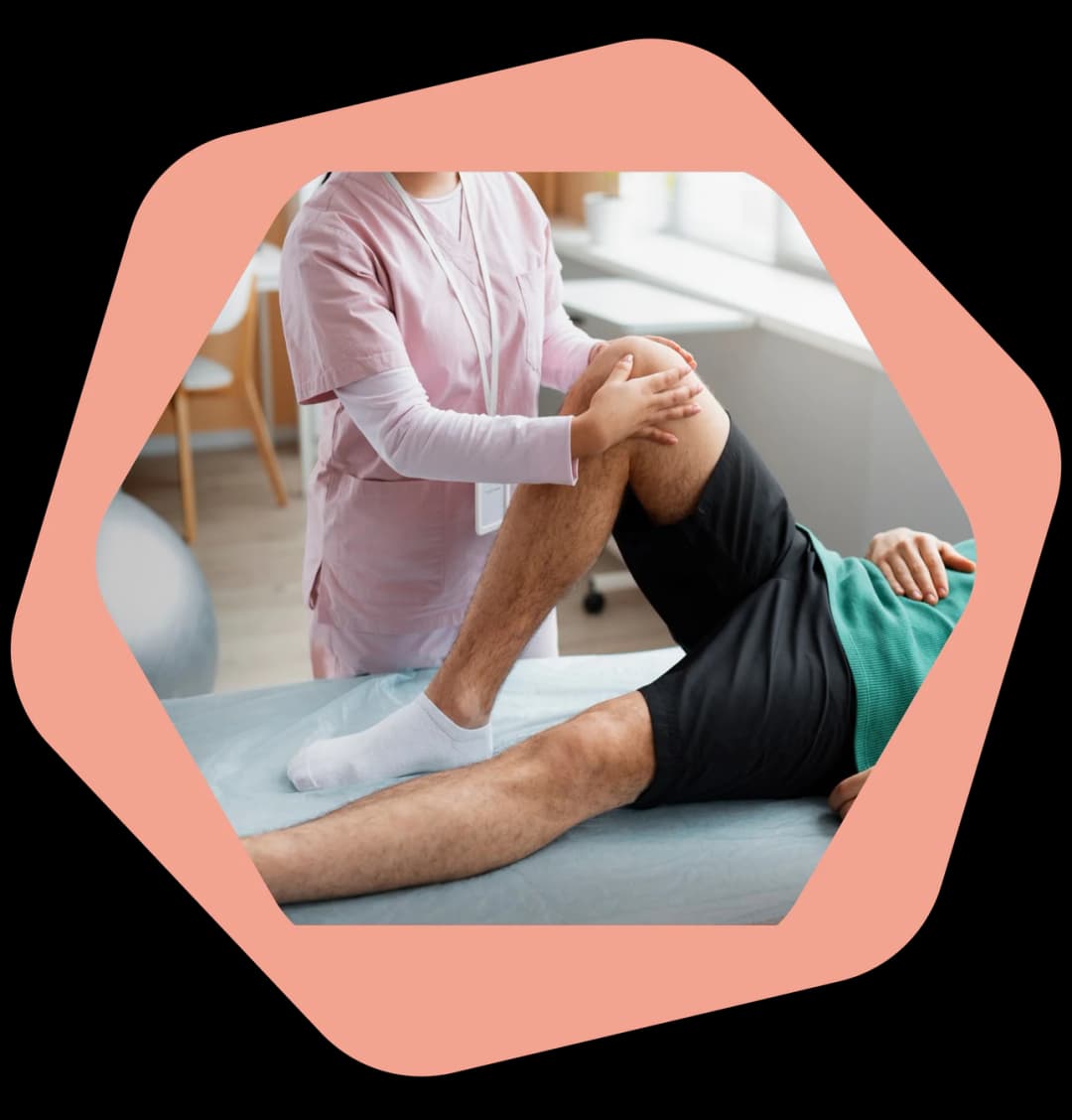
Home-based knee physiotherapy brings comprehensive physical assessment and clinical care directly to your living environment.
Initial home visits run between 45 and 60 minutes. The primary goal is establishing an accurate diagnosis, ruling out severe surgical or red flag issues, and starting your initial treatment plan.
Medical and functional history
- • How and when the knee pain started — gradual onset vs acute injury
- • Specific movements that trigger or ease pain — stairs, bending, walking
- • History of knee swelling or joint giving-way episodes
- • Prior surgical history or medical imaging results
- • Daily functional demands and personal activity goals
Physical and neurological examination
- • Inspection for joint swelling, quadriceps atrophy or bruising
- • Active and passive knee range of motion measurement
- • Manual muscle testing for quadriceps, hamstrings, gluteals and calves
- • Joint line palpation and ligamentous stability testing
- • Specific orthopaedic tests for meniscus, patella and cartilage integrity
In-home environmental assessment
- • Staircase mechanics: assessing how you ascend and descend your actual home stairs
- • Chair transfers: evaluating technique when getting up from low sofas or armchairs
- • Bed transfers: assessing how easily you swing your legs into bed
- • Flooring checks: reviewing rugs or slippery floors that increase fall risks while limping
Core treatment techniques used at home
- • Swelling reduction protocols: compression, elevation guidance and gentle active ankle pumps to drain joint fluid
- • Range of motion mobilisation: hands-on techniques and active drills to restore full knee extension and flexion
- • Quadriceps and VMO activation: isometric quad sets, straight-leg raises and biofeedback to restart inhibited muscles
- • Gluteal and pelvic stabilization: strengthening hip abductors and extensors to prevent valgus collapse during walking
- • Closed-kinetic-chain loading: step-ups, wall sits and shallow squats performed safely under clinical supervision
- • Balance and proprioception retraining: single-leg balance work on stable and soft surfaces
- • Stair negotiation retraining: practicing the lead-with-the-good-leg-up strategy on your actual home stairs
- • Activity modification and load pacing: structuring daily walks, chores and rest to build strength without flare-ups
Patient voice
"I couldn't descend my stairs without holding both handrails and wincing from sharp knee pain. Having a physiotherapist come to my flat in Manchester, show me how to activate my inner quad, and practice stepping down safely gave me my confidence back completely without needing surgery."
— Margaret T., Didsbury, Manchester
Rehabilitation for severe patellofemoral pain and mild osteoarthritis · Shared with consent
Authoritative sources cited in this section
• NICE NG226 — Osteoarthritis in over 16s nice.org.uk
• CSP — Lower limb clinical frameworks csp.org.uk
5. How Long Does Recovery Take for Knee Pain?
Knee rehabilitation timelines depend on the specific tissue involved, how long pain has been present, your baseline strength, and your adherence to daily home exercises.
Recovery varies by condition
Mild runner's knee or tendinopathy: Often improves significantly within 4 to 6 weeks of targeted hip and quad strengthening.
Degenerative meniscus tear: Typically requires 6 to 8 weeks of progressive loading to settle joint line inflammation and rebuild support.
Knee osteoarthritis: Initial pain relief usually occurs within 4 to 6 weeks, but long-term conditioning programmes run for 8 to 12+ weeks to build lasting joint capacity.
Ligament sprains (Grade I/II): Generally take 6 to 8 weeks to regain tissue stiffness, balance, and full functional strength.
Typical non-surgical recovery timeline
| Condition type | Average sessions | Typical timeline | Primary rehabilitation goal |
|---|---|---|---|
| Runner's knee / ITB syndrome | 4 to 6 sessions | 4 to 6 weeks | Patellar tracking restoration, hip control, return to running and sport. |
| Degenerative meniscus tear | 6 to 8 sessions | 6 to 8 weeks | Joint swelling control, joint desensitisation, load tolerance. |
| Mild to moderate knee OA | 6 to 8 sessions | 8 to 12 weeks | Quadriceps endurance, stair mechanics, walking distance extension. |
| Patellar tendinopathy | 6 to 8 sessions | 8 to 12 weeks | Progressive isometric to eccentric loading, tendon strain capacity. |
| Severe OA / delayed rehab | 8 to 12+ sessions | 3 to 6 months | Fall prevention, joint mobility preservation, functional independence. |
Factors that accelerate progress
- • Early quadriceps activation — restoring full knee straightening and quad firing early prevents stiffness and muscle wasting
- • Consistency with home exercises — daily practice drives neural adaptation far faster than weekly visits alone
- • Managing joint swelling — joint fluid reflexively shuts down quad activation, so keeping swelling down speeds recovery
- • Weight management support — reducing load on the knee during daily activity decreases cartilage stress
- • Good sleep and general health — restful sleep lowers nervous system sensitivity and speeds soft tissue repair
Signs that your knee is recovering
- • Decreased morning stiffness — waking with less knee tightness and bending the leg easily
- • Smoother stair negotiation — descending with less sharp pain under the kneecap or inside the joint line
- • Reduction in joint swelling — clearer contours around the kneecap after walking
- • Extended walking tolerance — walking longer distances before needing to sit down
- • Improved balance — feeling steady on one leg without the knee shaking or giving way
Evidence vs clinical reality — stopping too early
The evidence shows: Progressive resistance training targeting the lower limb muscles increases joint stability and reduces self-reported knee pain scores by 40% to 60% across clinical trials.
Clinical reality: Patients often stop doing their quad exercises as soon as the initial sharp pain vanishes. However, tissue capacity takes longer to build than pain takes to settle. Completing the full 8 to 12 week strength phase is what stops knee pain from returning when you resume heavy walking, running or gardening.
— Rosario I., MSc, MCSP, Band 7 Lead Specialist Musculoskeletal Physiotherapist
From the clinic — Rosario I., MSc, MCSP
Specialist Musculoskeletal Physiotherapist · HCPC Reg: PH74829
"Restoring full knee extension — straightening the leg completely flat — is our absolute top priority in week one. If a patient recovers their bend but remains five degrees short of full straightening, they will walk with a slight limp that overloads the kneecap and quad continually."
— Clinical observation, musculoskeletal physiotherapy, 2026
6. Managing Knee Recovery at Home in London and Manchester
Recovering from knee pain without surgery requires combining expert clinical appointments with sensible daily home habits.
Making practical home adjustments
Use higher seating initially: Avoid sitting on very low, soft sofas that force the knee into deep flexed angles under heavy load; choose higher, firm chairs.
Safe stair mechanics: Use the classic mnemonic "up with the good, down with the bad" when using handrails on stairs.
Clear walking paths: Remove loose rugs or clutter from hallways to prevent tripping while recovering your normal gait pattern.
Support under knees when resting: Place a small pillow under your knee briefly when resting if full extension is uncomfortable, but practice straightening it regularly.
Safe movement guidance
- • Keep knees aligned with toes — avoid letting the knee cave inward when standing up from a chair or stepping down
- • Push through the heels — drive through your heels when standing to engage the glutes and take pressure off the front of the knee
- • Break up sitting periods — avoid keeping the knee bent at 90 degrees for longer than 30 to 45 minutes continuously
- • Wear supportive footwear — use shoes with supportive insoles indoors rather than walking barefoot on hard floors during acute pain
Helpful daily habits for knee recovery
| Recommendation | Why it matters |
|---|---|
| Practice daily quad squeezes | Keeps the quadriceps muscle active and prevents rapid disuse atrophy. |
| Use ice after activity | Controls joint swelling and eases localized pain after walking or exercise. |
| Use heat before mobility drills | Relaxes tight surrounding hamstrings, calves, and quad tendons before stretching. |
| Step down stairs with control | Retrains eccentric quad strength and protects the patellofemoral joint. |
| Maintain short daily walks | Keeps articular cartilage hydrated through gentle, rhythmic joint loading. |
While most knee pain is mechanical and responds very well to physical therapy, certain signs require urgent medical, surgical, or emergency evaluation. Seek immediate medical attention (visit A&E or call 999) if your knee pain is accompanied by any of the following Red Flag signs:
Red flag symptoms — when to seek immediate medical evaluation
• Absolute inability to bear weight — complete inability to place any weight on the leg after acute impact trauma (possible fracture)
• True locked knee — the joint is physically stuck in a bent position and cannot be unbent (possible bucket-handle meniscus tear)
• Hot, red, systemically unwell joint — rapid swelling, intense redness, extreme heat with fever or chills (possible septic arthritis)
• Hot, painful, swollen calf muscle — severe calf tenderness, warmth and swelling below an aching knee (possible deep vein thrombosis)
• Visible joint deformity — gross anatomical deformity of the knee or a dislocated kneecap following a fall or collision
7. Same-Week Home Visits Across London and Manchester
Accessing specialized care quickly prevents compensation patterns (such as limping or overusing the opposite leg) from creating secondary hip or back pain. Specialist home visit physiotherapy services offer same-week appointments across Greater London and Greater Manchester.
Greater London
- • Central London: Westminster, Camden, Kensington & Chelsea, Islington, City of London
- • South London: Wandsworth, Lambeth, Southwark, Richmond, Merton, Bromley
- • North & West London: Hammersmith, Brent, Barnet, Ealing, Harrow, Hounslow
- • East London: Tower Hamlets, Hackney, Newham, Redbridge, Greenwich
Greater Manchester
- • Central Manchester: City Centre, Ancoats, Green Quarter, Castlefield, Spinningfields
- • South Manchester: Didsbury, Chorlton, Altrincham, Sale, Stockport, Hale
- • North & West Manchester: Salford, MediaCityUK, Trafford, Bolton, Bury, Oldham, Rochdale
Common misconceptions about knee pain & surgery
• Myth: an MRI showing a meniscus tear means you must have surgery. Fact: non-surgical physical therapy produces long-term relief equal to arthroscopic surgery for degenerative tears (NEJM, 2021)
• Myth: exercise wears out joint cartilage in knee osteoarthritis. Fact: cartilage lacks a blood supply and relies on rhythmic loading to pump nutrients into the tissue (NICE, 2023)
• Myth: running inevitably causes knee arthritis. Fact: recreational runners have lower rates of knee osteoarthritis than non-runners (BJSM, 2022)
• Myth: you should keep the knee completely still until pain disappears. Fact: complete rest causes up to 5% quad strength loss per week (CSP, 2023)
• Myth: you need a GP referral to see a private knee physiotherapist. Fact: private physiotherapy operates under direct access in the UK (CSP, 2023)
8. Conclusion
Resolving knee pain without surgery is an active, evidence-based process. With structured musculoskeletal physiotherapy, targeted quadriceps and hip conditioning, load management, and home environment adjustments, individuals can avoid operations, overcome arthritis or meniscus symptoms, and rebuild full movement confidence safely at home.
How to book home knee physiotherapy in London & Manchester
- • Initial contact: discuss your knee symptoms and arrange a home visit time
- • In-home clinical assessment: an HCPC-registered musculoskeletal physiotherapist evaluates your knee, movement, strength and home setup
- • Tailored rehabilitation plan: receive an individualized treatment plan focused on your daily functional goals, stair confidence and long-term joint health
Request a tailored plan
Bespoke plan — built for your knee & goals
Tell us your diagnosis, activity level and daily demands. A MedGo2U specialist builds your personalised plan within 24 hours.
Buy a ready-made plan
Start immediately — progressive knee programme
Structured, evidence-based. Quadriceps, gluteal and loading progressions included. Download instantly and begin today.
Frequently Asked Questions
Yes. Clinical trials confirm that structured physical therapy produces functional outcomes and pain relief equivalent to arthroscopic meniscus surgery for degenerative tears, without surgical risks.
NEJM, 2021
Yes. Strengthening the surrounding quadriceps, hamstrings and gluteals reduces mechanical joint compression during weight-bearing, significantly easing pain and increasing walking tolerance.
NICE NG226
Most acute conditions such as runner's knee or mild sprains require 4 to 6 sessions. Degenerative meniscus tears or osteoarthritis typically require 6 to 8 sessions combined with a home exercise plan.
Same-week home visit appointments are available across Greater London and Greater Manchester for acute knee injuries and chronic joint pain.
No. Private physiotherapy in the UK operates under direct access. Your physiotherapist conducts a full clinical exam and will advise if imaging is required.
Rarely. Modern physiotherapy utilizes load management (modifying distance, surface, or speed temporarily) rather than enforcing complete rest.
Isometric quadriceps squeezes pressing the back of the knee flat against a towel, straight-leg raises, and glute bridges activate protective muscles safely without irritating the knee joint.
Going down stairs requires eccentric quadriceps contraction and places higher compressive forces on the kneecap (patellofemoral joint) than climbing upward.
Wear loose shorts or flexible exercise trousers that roll easily above the knee so your physiotherapist can inspect joint swelling, alignment and muscle contraction.
For many patients with mild-to-moderate osteoarthritis, targeted strengthening, joint mobility work and weight management delay or eliminate the need for joint replacement indefinitely.
Use ice packs wrapped in a towel for 15 minutes for acute swelling or sharp pain after activity. Use gentle heat for chronic stiffness or tight muscles before doing mobility exercises.
Home visits allow your physiotherapist to evaluate real-world challenges such as your exact stair height, armchair depth and flooring, delivering practical, context-specific recovery results.
Complete inability to bear weight after trauma, a locked knee joint, severe swelling with fever, hot painful calf swelling, or visible joint deformity requires immediate medical evaluation at A&E or by calling 999.
Find a physio near you
Find a verified knee physio near you
Search HCPC-registered musculoskeletal physiotherapists by postcode — Manchester, London & UK-wide. Same week availability.
Related conditions we treat
Knee Pain Physiotherapy Guide
medgo2u.com/uk/blog/physiotherapy-for-knee-painA broader introduction to knee assessment, common diagnoses and what a first physiotherapy appointment involves.
ACL Injury Recovery — The Complete Guide
medgo2u.com/uk/blog/acl-injury-recovery-sports-physiotherapyWhere a knee injury involves the cruciate ligament, rehabilitation follows a distinct four-phase, criteria-driven pathway.
Sports Physio Exercises for Knee Pain
medgo2u.com/uk/blog/best-sports-physio-exercises-for-knee-painLoading progressions for active adults — quad, gluteal and calf work that protects the patellofemoral joint.
Sports Injury Physiotherapy at Home
medgo2u.com/uk/blog/sports-injury-physiotherapy-at-homeLigament sprains, tendinopathy and return-to-sport testing for athletes and recreational runners.
Back Pain & Sciatica
medgo2u.com/uk/blog/back-pain-sciatica-physiotherapy-at-homeKnee pain is sometimes referred from the lumbar spine or hip. Accurate screening separates local from referred causes.
Post-Surgical Rehabilitation
medgo2u.com/uk/services/post-surgery-rehabilitationWhere surgery is unavoidable — knee replacement, osteotomy or cartilage repair — structured post-operative rehab protects the result.
Home Physiotherapy Exercises
medgo2u.com/uk/blog/physiotherapy-exercises-at-homeDaily quad and gluteal work is the single biggest predictor of knee recovery between appointments.
Physiotherapy for Chronic Conditions
medgo2u.com/uk/blog/physiotherapy-chronic-conditions-managementLong-term osteoarthritis management focuses on maintaining walking tolerance and independence rather than cure.
Areas We Cover — Manchester & London
MedGo2U physiotherapists provide home visits and video consultations across Manchester and all 32 London postcode districts. Same-week appointments are typically available in all areas listed.
Manchester — home visits and video consultations across Greater Manchester
Book a Verified Physio Near You
References
About the medical reviewer
Ken Hong, MSc, BSc
Band 6 Physiotherapist · NHS Manchester · Musculoskeletal & Sports Rehabilitation · Home-Based Rehabilitation
Ken Hong is a qualified physiotherapist with over three years of clinical experience in home-based rehabilitation, musculoskeletal physiotherapy, and sports injury management. He currently works as a Band 6 Physiotherapist within the NHS in Manchester, where he delivers evidence-based, patient-centred care to help individuals restore movement, function, and independence.
His clinical expertise includes assessing and treating a wide range of musculoskeletal conditions, sports injuries, and rehabilitation needs through personalised treatment plans and holistic care. Ken is passionate about empowering patients to achieve lasting recovery and improve their overall quality of life.
Known for his strong communication skills, empathy, and collaborative approach, Ken works closely with patients and multidisciplinary teams to provide effective, tailored rehabilitation that supports long-term health and wellbeing.
Medical Disclaimer — This content is for educational purposes only and does not constitute professional medical advice, diagnosis, or treatment. Always consult a qualified, HCPC-registered physiotherapist or medical professional before beginning any rehabilitation programme. Individual recovery timelines and clinical decisions vary significantly. Medically reviewed by Ken Hong, MSc, BSc — 11 August 2026 · Next review: August 2027

Join the movement for fair and flexible healthcare
WORK WITH MEDGO2U
Are you a qualified HCPC-registered physiotherapist looking for flexible work across the UK? Join MedGo2U and start providing home visits or online consultations at your convenience.
Sign Up as a PhysiotherapistWritten by
Rosario I.
11 Aug 2026 · 22 min read
Medically reviewed by
Ken Hong, MSc, BSc
© 2026 MedGo2U. All rights reserved.


